
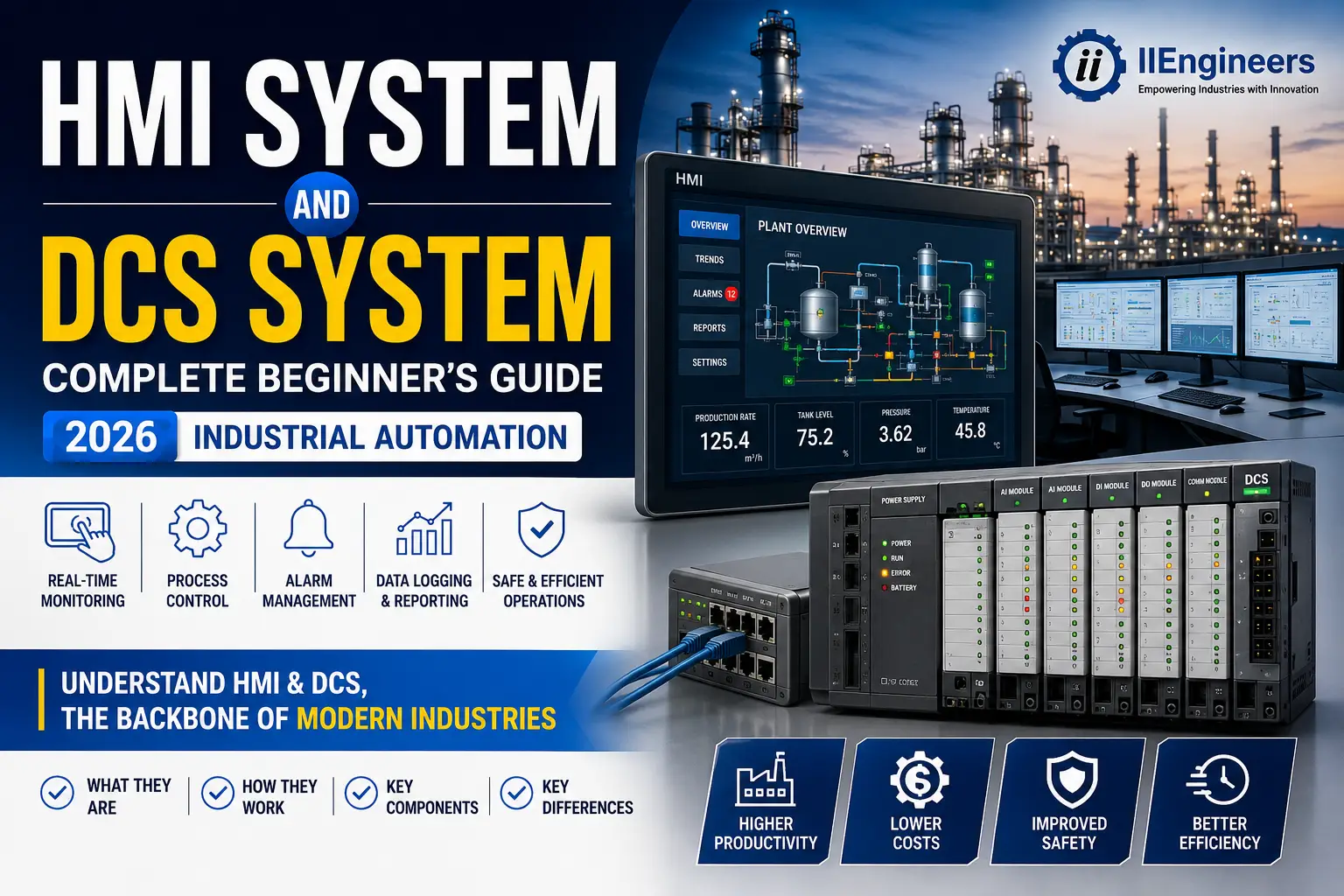
HMI System and DCS System
Industrial automation has transformed the way modern industries operate. From manufacturing plants to power stations, automation systems improve productivity, enhance safety, and reduce operational costs. Among the most important technologies used in industrial automation are the Human-Machine Interface (HMI) and the Distributed Control System (DCS).
Although HMI and DCS often work together, they serve different purposes. An HMI allows operators to monitor and control industrial processes through a graphical interface, while a DCS manages and controls complex industrial operations through multiple distributed controllers.
In this guide, we’ll explain everything you need to know about HMI and DCS systems, including their components, functions, applications, benefits, and differences.
What Is an HMI System?
A Human-Machine Interface (HMI) is a software and hardware solution that enables communication between people and industrial machines. It provides operators with a visual interface where they can monitor machine performance, view process data, receive alarms, and control equipment.
Instead of manually checking each machine, operators can monitor the entire production process from a single screen. Modern HMIs are typically displayed on industrial touch panels, computers, or operator stations and are designed to simplify industrial operations.

Why Is an HMI Important?
Without an HMI, operators would have to rely on individual switches, indicator lights, and manual inspections to manage industrial equipment. An HMI centralizes all important information, making operations faster, safer, and more efficient.
HMIs help operators:
- Monitor real-time production data
- Start and stop machines
- Adjust process parameters
- View system alarms
- Analyze historical production data
- Improve production efficiency
- Reduce machine downtime
Key Components of an HMI System
Display Interface
The display interface is the most visible part of an HMI. It presents real-time information using graphics, charts, trends, gauges, and process animations. Modern HMIs use high-resolution touchscreen displays that are easy to operate.
Control Interface
Operators use the control interface to interact with machinery. From this screen, they can start motors, open valves, adjust production settings, or reset alarms.
Communication Interface
An HMI communicates with industrial devices such as PLCs, sensors, drives, and controllers using communication protocols including:
- Ethernet/IP
- Modbus
- Profinet
- Profibus
- OPC UA
- MQTT
These communication networks allow the HMI to display live process information.
Main Functions of an HMI
Real-Time Monitoring
Operators can monitor machine status, production levels, temperatures, pressures, flow rates, motor speeds, and other critical process values in real time.
Process Control
HMIs allow users to control industrial equipment directly from the graphical interface. Operators can start production, stop machines, change recipes, or adjust operating parameters.
Alarm Management
When abnormal conditions occur, such as high temperature or low pressure, the HMI immediately displays alarms. This enables operators to respond quickly and prevent equipment damage.
Data Logging and Reporting
Most modern HMIs record production data, machine events, alarms, and operating history. These reports help maintenance teams identify recurring problems and improve production efficiency.
Benefits of HMI Systems
An HMI offers numerous advantages for industrial facilities.
- Easy-to-use graphical interface
- Faster operator response
- Improved production monitoring
- Better decision-making through real-time data
- Reduced machine downtime
- Improved process visibility
- Increased operational efficiency
- Better maintenance planning
- Enhanced workplace safety
Common Applications of HMI
HMI systems are used in almost every industrial sector, including:
- Manufacturing
- Food and beverage processing
- Pharmaceutical plants
- Oil and gas facilities
- Water treatment plants
- Chemical industries
- Power generation
- Building automation
- Packaging systems
- Mining operations
What Is a DCS System?
A Distributed Control System (DCS) is an advanced industrial automation system designed to control large and complex industrial processes. Instead of using one central controller, a DCS distributes control across multiple controllers installed throughout the plant.
Each controller is responsible for a specific section of the process, while all controllers communicate through a high-speed industrial network.
Operators can monitor and control the complete plant from centralized HMI workstations.
How Does a DCS Work?
A DCS continuously collects information from sensors installed throughout the plant.
Each controller processes the data independently and sends commands to field devices such as valves, pumps, motors, and actuators.
The results are displayed on HMI operator stations, allowing engineers to monitor the entire process in real time.
Because control is distributed, the failure of one controller usually affects only a small portion of the plant rather than the entire operation.
Main Components of a DCS
Distributed Controllers
Controllers perform control calculations, execute automation logic, and manage process operations for individual plant sections.
Field Devices
Field devices include:
- Temperature transmitters
- Pressure transmitters
- Flow meters
- Level sensors
- Control valves
- Motors
- Pumps
- Actuators
These devices collect process data and execute control commands.
Human-Machine Interface (HMI)
The HMI provides operators with a complete overview of the plant. Through the HMI, users can monitor production, adjust process parameters, acknowledge alarms, and review historical trends.
Communication Network
The communication network connects controllers, HMIs, servers, and field devices using industrial communication protocols such as:
- Ethernet
- Foundation Fieldbus
- Profibus
- Profinet
- Modbus TCP/IP
Reliable communication is essential for maintaining plant stability.
Key Features of a DCS
Distributed Control
Each controller independently manages its assigned process area, improving system reliability.
Scalability
A DCS can easily expand as new production lines or plant sections are added.
High Reliability
Most DCS systems include redundant controllers, servers, communication networks, and power supplies, ensuring continuous operation even during equipment failures.
System Integration
Modern DCS platforms integrate with PLCs, SCADA systems, historians, MES software, ERP systems, and Industrial Internet of Things (IIoT) platforms.
Benefits of a DCS System
Industries choose DCS systems because they provide:
- Superior process control
- Improved product quality
- High system availability
- Reduced downtime
- Enhanced plant safety
- Centralized monitoring
- Flexible expansion
- Easier maintenance
- Better process optimization
Industries That Use DCS
DCS systems are commonly found in industries where continuous production is critical.
These include:
- Oil and gas
- Petrochemical plants
- Chemical processing
- Power generation
- Water and wastewater treatment
- Cement manufacturing
- Paper mills
- Pharmaceutical production
- Steel manufacturing
- Food processing
HMI vs DCS: What’s the Difference?
Although HMI and DCS work together, they perform different functions.
| Feature | HMI | DCS |
|---|---|---|
| Primary Purpose | Operator Interface | Process Control System |
| Main Function | Monitoring and Control | Distributed Process Automation |
| User Interaction | High | Indirect through HMI |
| Controllers | No | Yes |
| Used For | Machine visualization | Large industrial plants |
| Complexity | Moderate | High |
| Scalability | Limited | Excellent |
| Typical Users | Operators | Engineers and Plant Managers |
Simply put, an HMI is the window through which operators view and control the process, while the DCS is the system performing the actual control behind the scenes.
HMI and DCS Working Together
In modern industrial plants, HMI and DCS operate as a unified automation solution.
Sensors send process data to DCS controllers.
The DCS analyzes this information and controls equipment based on the programmed logic.
The HMI displays process information, trends, alarms, and operating status to plant personnel.
Operators use the HMI to interact with the DCS without directly accessing the controllers.
This combination creates a safe, efficient, and highly reliable automation environment.
Future of HMI and DCS Systems
Industrial automation continues to evolve with Industry 4.0 and Smart Factory technologies.
Modern HMI and DCS platforms now support:
- Cloud connectivity
- Remote monitoring
- Industrial Internet of Things (IIoT)
- Artificial Intelligence (AI)
- Predictive maintenance
- Big data analytics
- Digital twins
- Cybersecurity enhancements
These innovations enable industries to make faster, data-driven decisions while improving productivity and reducing operating costs.
Final Thoughts
HMI and DCS systems are essential technologies in today’s industrial automation landscape. While an HMI provides operators with an intuitive interface for monitoring and controlling processes, a DCS delivers the distributed intelligence required to manage complex industrial operations with precision and reliability.
Understanding how these systems work together is valuable for engineering students, technicians, automation professionals, and plant operators. As industries continue embracing digital transformation, expertise in HMI and DCS technologies will remain one of the most sought-after skills in industrial automation.
At IIEngineers, we provide professional training and industrial solutions in PLC, HMI, SCADA, DCS, VFD, ETAP, Energy Monitoring Systems, and Industrial Electrical Engineering. Whether you’re starting your automation career or upgrading your technical skills, our industry-focused programs are designed to prepare you for real-world challenges.
Visit https://iiengineers.com to explore our training programs, technical resources, and automation services. For inquiries, contact us at info.iiengineers@gmail.com and take the next step toward mastering industrial automation.